
profile image

Leah Albrow

Protoplanetary disc logo
I’m a graduate student in the EAPS department at MIT working with Dr. Richard Teague on protoplanetary discs, the structures of gas and dust around young stars where planets form. I’m interested in using observations from telescopes such as ALMA and JWST in combination with computational modelling and machine-learning methods to study how disc substructures and planetary systems form in these environments. I also have a soft spot for interstellar objects, and what they reveal about planet formation beyond our own solar system.

I grew up in New Zealand and did my undergraduate degree at the University of Canterbury. Outside of research, I enjoy learning about ancient history, attending rock and metal concerts, watering my houseplants, and hiking while birding.

Research

The ejection velocities of interstellar objects signpost their progenitor system architectures

The ejection velocities of interstellar objects signpost their progenitor system architectures

Leah Albrow, Michele T. Bannister, John C. Forbes, David Nesvorny

We investigated how the initial architectures of planetary systems impact the production and kinematics of interstellar objects. Using N-body simulations of 2,461 planetary configurations, we tracked how dynamical instabilities eject planetesimals into interstellar space. We find that typical ejections are relatively slow, causing unbound planetesimals to form compact tidal streams — meaning future surveys like LSST are well-positioned to detect multiple ISOs from the same native system.
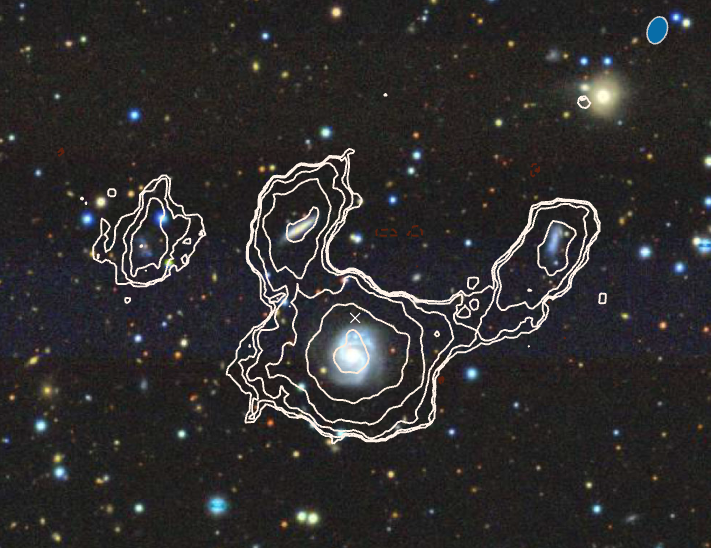
A serendipitous discovery of HI-rich galaxy groups with MeerKAT

A serendipitous discovery of HI-rich galaxy groups with MeerKAT

Marcin Glowacki, L Albrow, T Reynolds, E Elson, EK Mahony, JR Allison

My first paper, from a summer internship at ICRAR. A short MeerKAT observation pointed at an unrelated target serendipitously turned up 49 HI-rich galaxies, several forming part of larger interacting groups. I worked on the dark matter rotation curve modelling and contributed to the cross-catalogue analysis. This highlights MeerKAT’s potential for serendipitous science, and points to the many more HI-rich galaxies likely hidden within existing archival datasets.

Outreach

During my undergrad at Canterbury I tutored introductory physics and astronomy and helped run the physics labs, and led public tours and observing nights at the Townsend Teece Telescope. Since moving to the US, I’ve been involved with the Boston chapter of Astronomy on Tap and the Letters to a Pre-Scientist pen-pal program, which connects working scientists with middle-school students from under-resourced communities. I also enjoy speaking to schools and local astronomy groups — feel free to get in touch!